





The latest GCC
E-Performance Index 2022 reveals that all countries from the Gulf Cooperation
Council (GCC) region have performed exceptionally well on five major global
indicators, displaying significant progress in digital transformation. The
report was issued by Orient Planet Research (OPR), an independent unit of
Orient Planet Group (OPG), in collaboration
with information and communications technology (ICT) expert and independent
researcher Abdul Kader Al Kamli.
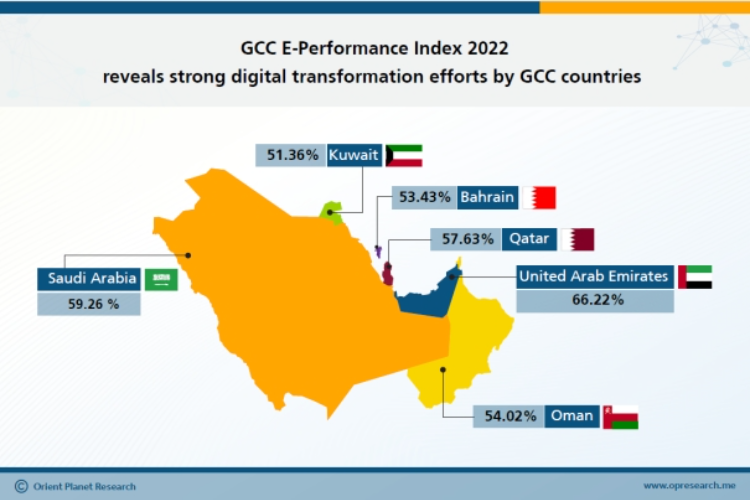
The UAE achieved tangible
growth in the GCC E-Performance Index with an average score of 66.22, followed
by Saudi Arabia with an average rating of 59.26 and Qatar with 57.63. Oman,
Bahrain and Kuwait scored average ratings of 54.02, 53.43 and 51.36
respectively. The report highlights the increased spending on latest
technological solutions to achieve digitally inclusive economies. According to
a recent report, UAE’s ICT spending is estimated to reach USD 23 billon by
2024, while Qatar’s spending will be around USD 9 billion, and Kuwait’s
spending is predicted to reach USD 10.1 billion by 2024.
The GCC countries have
increasingly focused on the roles of science and technology in building
research development and innovation (RDI) capacity to create national innovation
systems (NIS). The World Economic Forum highlighted the unique set of
characteristics of the GCC countries that presents numerous opportunities in leveraging
emerging technological solutions to create opportunities. The introduction of 5G
and associated use cases, such as education, health, government and smart
cities, can help mitigate some regional and local challenges, including natural
resource management and economic diversification, with a view towards
sustainable development and inclusive growth.
Nidal Abou Zaki, Managing
Director, Orient Planet Group, said “The GCC countries have taken major strides
for an overall digital transformation. The GCC E-Performance Index 2022,
highlights the preparedness of the GCC nations to strengthen their global
position in the evolving digital world. The countries have expanded their
digital sectors in the last decade, investing in digital infrastructure,
adopting e-government platforms, and launching technology parks and business
incubators. GCC countries have constantly implemented innovative strategies to
boost digital transformation reflecting the region’s competitiveness to secure global
positions in technology. The GCC countries are engaging in large-scale
transformations and economic diversification strategies to maximize efficiency
throughout their economies and digitisation will be the key enabler in
achieving such goals.”
The GCC E-Performance Index aggregates each countries’
performance in the top five global indices – The Global Talent Competitiveness
Index (GTCI) 2021 by INSEAD, The Network Readiness Index (NRI) 2021 by
Portulans Institute, Government AI Readiness Index 2021 (GAR) by Oxford
Insights, The Global Innovation Index (GII) 2022 by World International
Property Organization (WIPO) and UN E-Government Development Index (EGDI) 2022
by the United Nations.
There have been major
developments in the UAE with the recent Al Amal (Hope) Mars mission, which helped
raise the profile of technology skills in the GCC. Though the region is still reliant
on oil and gas production and exports, countries are making efforts to
diversify their economies. S&P Global projected that non-oil GDP in
Gulf countries will reach nearly 37 per cent by 2022 as compared to 29.2
percent in 2012.
The GCC region’s ICT development has strengthened the
digital economy, enhanced productivity, and created efficient means for direct
access to government e-services. A report by Global Data projected Bahrain’s spending
to grow at a compound annual growth rate (CAGR) of 8.6 per cent from USD 1.4 billion
in 2019 to USD 2.1 billion by 2024. Another report by International Data
Corporation (IDC), projects Saudi Arabia to spend USD 30.9 billion, with public
sector spending reaching USD 3 billion by the end of 2022.
Abou Zaki further highlighted
that the GCC E-Performance index reflects the GCC member countries’ efforts to
achieve overall digital transformation, along with current developments and
future avenues that may arise. He stated that trends such as bolstered digital
transformation investments, citizen-centric e-government services, multi-cloud
strategies, ventures in the metaverse, are setting the scene for a dynamic
digital future. Relevant entities, decision-makers and policymakers can
leverage the findings of the index to devise strategies to enhance their
digital transition efforts. He emphasised that the GCC nations are gaining
momentum in terms of development in technological infrastructures and paving
way for economic diversification.
Abdul Kader Al Kamli, ICT
expert and independent researcher, said: “The GCC E-Performance Index reveals
the strong position of GCC countries in five top global indexes, with the UAE
leading the region. The GCC countries has been at the forefront of digital
transformation efforts, and its efficient strategies will reinforce the
nation’s global position in the sector. There have been tremendous developments
in digital innovations in the region, and we can expect an upward trajectory in
terms of digital innovation.”
Recognising the plethora of
opportunities and challenges posed by Fourth Industrial Revolution, governments
across the GCC have prioritised digital transformation keeping it at the core
of their economic and social development plans. As a key component of their respective
Vision 2030 plans, the UAE, Saudi Arabia, and Kuwait have each launched various
significant digital initiatives. The Expo 2020 Dubai became the first World
Expo and the Arab world’s biggest event to utilise a multi-cloud approach for
its infrastructure, leveraging Etisalat 1C and AWS.
The GTCI 2021 assesses the
capability of countries to grow, attract and retain talent and includes 175
cities from 79 economies around the world. According to the GTCI report, the
UAE’s key asset is its capability to attract talent, that has been boosted by
its excellent external openness. The nation also ranks in the top 10 position for
the sub-pillar related to access to growth opportunities and has good
possibilities for lifelong learning.
The NRI 2021 ranks 130
countries in terms of network readiness in four key pillars – technology,
people, governance, and impact. According to the NRI report, the UAE performed
strong across all pillars, with particular strength in the people pillar. Saudi
Arabia improved by one position in the NRI 2021 due to increased performance
results in the technology pillar.
The GAR 2021 considers the
integration of AI in improving delivery of public services and ranks countries
on a total of 42 indicators across the government sector, technology sector,
and data and infrastructure. According to the GAR report, the GCC region is one
of the most diverse in the world in its Government AI Readiness scores. The
report further highlighted Oman for its capabilities to adopt AI, with the
nation’s upcoming AI strategy that will boost its strengths.
The GII 2022 measures the
performance of 132 countries in the innovation sector and monitors latest
trends in global innovation. It considers seven categories, which are, institutions,
human capital and research, infrastructure, market sophistication, business
sophistication, knowledge and technology outputs, and creative outputs, which
accounts for a total of 84 indicators.
Lastly, the EGDI ranks 193 UN
member nations for their development and progress in achieving a digital
government system. According to the EDGI report reveals that currently the UAE
Government offers 500 online services for public institutions and users. The
report further highlights Saudi Arabia's exceptional performance in various
fields of e-government development, reporting a significant improvement economically
and socially.
The research team for GCC
E-Performance Index calculated the average of each GCC country per indicator on
the basis of a unified scale of 0 to 100, keeping in mind that all indicators
do not utilize the same scale. The scores were adjusted according to the
calculated average, staring from highest value
The GCC E-Performance Index
evaluates GCC member countries on several different parameters indicative of
growth, which are based on their performance in major global indices. The index
highlights the increasing investment by the GCC countries for integration of
latest technological solutions across various sectors including healthcare,
technology, food services, aviation, and education.