
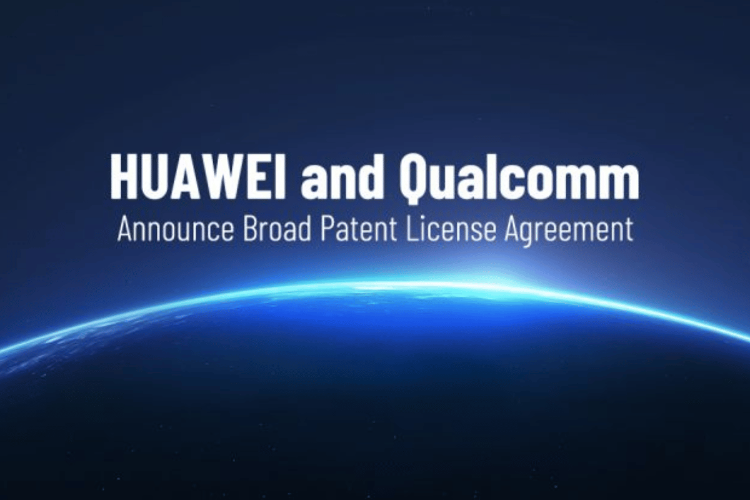



Huawei and Qualcomm today announced a broad, multi-year
patent license agreement covering cross-licenses to the companies’ patent
portfolios across a range of technology fields, including 5G, compute,
artificial intelligence and networking.
The agreement also includes Qualcomm’s purchase of certain
Huawei U.S. patents in the areas of compute, AI, networking and other
technologies. The transaction is expected to close following receipt of the
necessary regulatory approvals.
The agreement reflects both companies’ commitment to
protecting intellectual property rights and to licensing practices consistent
with fair, reasonable and non-discriminatory, or FRAND, principles. It also
represents mutual recognition of the value of each company’s innovation and
technological contributions to the global communications industry.
The agreement marks Huawei’s first patent license with
Qualcomm covering 5G technologies. Following the signing of the agreement, the
expected contract value of Huawei’s patent licensing agreements to date has
exceeded US$6.9 billion.
The transaction relates exclusively to the parties’ patent
portfolios and does not involve any other form of business cooperation. It was
reached through amicable negotiations between Huawei and Qualcomm.
“Huawei’s decades of sustained investment in fundamental
R&D have driven innovation and progress in mobile communications and other
technology fields. Huawei’s broad contributions to the 4G and 5G standards,
including near-physical-limit signal transmission technologies using polar
codes, have established Huawei’s leadership in the mobile communications
industry and continued to transform the way people communicate and live,” said Alan
Fan, Chief Intellectual Property Officer of Huawei.
“This agreement not only demonstrates the value of Huawei’s
innovations, but also recognizes Qualcomm’s foundational contributions to
modern communication technologies,” Fan added.
“Qualcomm has invested in foundational wireless technologies
that have enabled successive generations of mobile innovation and earned broad
recognition across the global wireless industry,” said John Han, Executive
Vice President and General Manager of Qualcomm Technology Licensing.
“This agreement reaffirms industry recognition of Qualcomm’s
leadership in 5G technologies and the success of its 5G standard-essential
patent licensing program. It also reflects Qualcomm’s recognition of Huawei’s
continued innovation and intellectual property in 5G and other technology
fields,” Han added.
Long-Term Investment in Innovation and R&D
Huawei has continued to invest heavily in research and
development as part of its long-term commitment to technological innovation.
Between 2007 and 2025, the company invested more than CNY1.8 trillion in
R&D.
By the end of 2025, Huawei held more than 165,000 active
granted patents worldwide, within a global portfolio comprising
approximately 296,248 active patents and patent applications.
The Huawei U.S. patents being acquired by Qualcomm under the
agreement represent approximately 0.23% of Huawei’s global active patent and
patent application portfolio.
Huawei had also ranked as the world’s leading applicant
under the Patent Cooperation Treaty, or PCT, for nine consecutive years
through 2025.
In the United States, Huawei was granted more than 3,000
patents in 2025, ranking fourth by the number of patents granted during the
year. The company was also the second-largest patent applicant in Europe,
according to the European Patent Office.
In China, Huawei remained one of the country’s leading
patent holders, with more than 55,000 active patents by the end of 2025.
Huawei Technologies Used Across Billions of Devices
Huawei’s intellectual property portfolio is widely used
across the global communications and consumer technology industries.
By the end of 2025, more than 3.2 billion 5G devices
had used Huawei’s patented cellular technologies.
More than 1.6 billion consumer electronic devices,
excluding mobile phones, had used Huawei’s patented Wi-Fi technologies,
while more than 4.1 billion multimedia devices, excluding mobile phones,
had incorporated Huawei’s patented video codec technologies.
By the end of 2025, 53 Fortune Global 500 companies
had obtained licenses to Huawei patents.
Huawei’s history in intellectual property licensing spans
more than two decades. The company made its first IP licensing payment to
Qualcomm in 2001 and received its first IP licensing income from Motorola in
2011. Since 2021, Huawei’s IP licensing revenue has turned positive, reflecting
the growing value and global adoption of its intellectual property portfolio.