
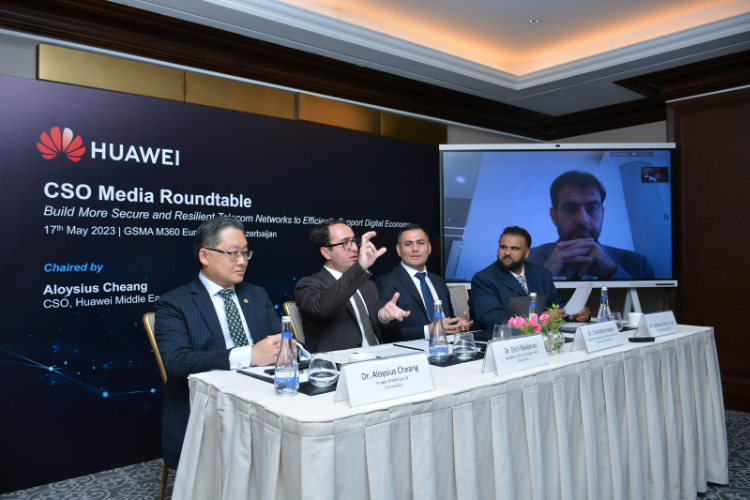

Huawei Middle
East and Central Asia joined a high-level media roundtable on day two of the
GSMA M360 EURASIA 2023 conference in Baku, Azerbaijan, to discuss the latest telecom
cybersecurity trends, innovations, and contribute methods to tackle the
associated threats among industry actors together. The open discussion aimed at
aligning strategic priorities for the region, deepening engagement and steering
collaborative efforts in the industry to advance collective action for cyber
stability in the telecom industry.
Under the theme
of “Build more secure and resilient telecom networks to efficiently support the
future digital economy,” participants in the panel discussed various topics,
including collaborations among network operators and their partners, suppliers
and customers in defending against telecom cybersecurity, how regulators could promote
local telecom industry’s cybersecurity development, and the role that
cybersecurity plays in safeguarding critical information infrastructure and the
digital economy, among other topics.
Dr. Tural
Mammadov, Director of Director of the Azerbaijan Computer Emergency Response
Center (CERT), was joined in the panel by Dr. Mohammad Khaled, Director,
Business Development and Strategic projects, e& enterprise, Dr. Haitham
Hilal Al Hajri, Sr. Executive – Cyber Security Projects, Oman National CERT, Dr.
Elvin Balajanov, Chairman of the Board, Azerbaijan Cybersecurity Organization
Association and Dr. Aloysius Cheang, Chief Security Officer, Huawei Middle East
& Central Asia.
The telecom
industry has become an integral part of modern society and is recognized as a
critical infrastructure industry (CII). It plays a vital role in connecting
people, businesses and governments, facilitating communication, information
sharing and commerce on a global scale.
However, as
telecom networks become more complex and interconnected, they become more
vulnerable to cyber threats. Cybersecurity of telecoms is a critical component
of national security, and therefore, it is essential to bring together telecom
stakeholders to promote the development and optimization of telecom
cybersecurity. This includes working closely with telecom service providers,
equipment manufacturers, government agencies, and other stakeholders to
identify and mitigate cybersecurity risks, develop and implement best
practices, and raise awareness about the importance of cybersecurity in
telecom.
Dr. Tural
Mammadov thanked the organizers, participants and sponsors for arranging the
event in Baku while reiterating the country’s commitment to the highest
cybersecurity standards. “We join the international community in highlighting
the risks posed by cybercrime. Likewise, we want to work with our global
partners towards joint actions in defending telecom networks, which is critical
in leveraging all the digital economy opportunities.”
Dr. Mohammad
Khaled said, “As an operator, securing our networks against cyber threats and
creating safe digital cyberspace remains one of our most important tasks,
especially as we enter a new era of connectivity and cognitive technologies. We
realize that cyber threats are global in nature – and solutions must be as
well. We are therefore proud to be here, joining other partners and
stakeholders in finding joint outcomes to a common threat.”
Dr. Haitham Hilal
Al Hajri said, “Today, the progression towards an interconnected cyber world
has become a reality. Unfortunately, this has increased the threats from malicious
actors and protecting our digital assets is a concern for all countries. Cybersecurity
is a shared responsibility and national security agencies, telecom providers and
ICT industry players should work together to achieve a more robust
cybersecurity posture, so telecom providers can continue to deliver
cutting-edge digital services unimpeded by cyber threats.”
Dr. Elvin
Balajanov said, “We are proud to host our partners and friends here in
Azerbaijan as we address the cyber risks that threaten the health of our
networks and, by extension, our socioeconomic growth. Safeguarding our critical
information infrastructure is a key government priority in Azerbaijan as these critical
systems possess functionality that, if disrupted, can pose significant harm to
the interests of the state, society, and citizens. Therefore, it is crucial
that telecommunications providers implement appropriate safeguards, protocols,
and technologies to mitigate risks and protect our critical information
infrastructure.”
Dr. Aloysius
Cheang said, “We need to consider how to meet the increasingly strict
compliance requirements of regulators on the one hand and how to provide secure
and trustworthy products and services that fulfill our commitments to customers
on the other. We must also embrace a defense-in-depth approach to provide
better security, ensure business continuity, resiliency, improve efficiency and
customer experience while always protecting user privacy.”
Global standards,
internationally agreed processes and industry best practices are critical in
addressing cyber threats effectively. As such, building and implementing an
end-to-end global cybersecurity and privacy protection assurance system is one
of Huawei’s key strategies. In compliance with applicable laws and regulations
in the countries where it operates and international standards, Huawei has created
an effective, sustainable, and reliable cybersecurity and privacy protection
assurance system by referring to the requirements of regulators and customers
and industry best practices.
NESAS/SCAS is an
ideal example of global collaborative efforts in addressing cybersecurity. It offers
a standardized cybersecurity assessment mechanism jointly defined by GSMA and
3GPP, the telecom industry’s leading standards-setting organizations) and GSMA 5G
Cybersecurity Knowledge Base to provide useful guidance on 5G security risks
and mitigation measures. Huawei has been proactively involved in the telecom
cyber security standardization activities led by GSMA ITU-T, 3GPP, and IETF
etc., and has joined security organizations such as OIC-CERT, FIRST and
partnered with mainstream security companies to ensure the cyber security of
its customers and promote the healthy development of industries.
Huawei believes cybersecurity
and privacy are common challenges that all stakeholders – including
governments, industry and standards organizations, enterprises, technology
suppliers, and consumers – have a shared responsibility to confront. Huawei
actively works with governments, customers, and industry partners to address
cybersecurity and privacy challenges, thereby reinforcing the need to treat cybersecurity
as a team sport and maintaining an open and collaborative environment that
encourages innovation and transparency. Through these efforts, Huawei advocates
for cybersecurity to be viewed as the key to protecting our digital assets and
leveraging it to support business.