




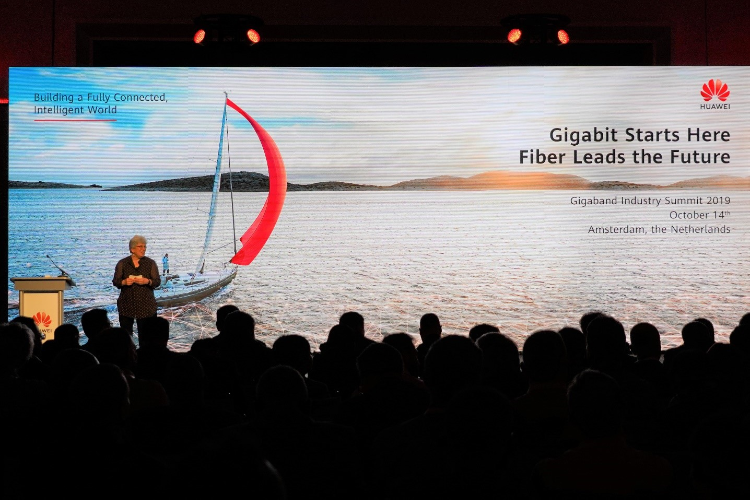

Today, at the 2019 Broadband
World Forum Gigaband Industry Summit, European Telecommunications Standards
Institute (ETSI), China Academy of Information and Communications Technology
(CAICT), Wi-Fi Alliance®, well-known analyst firm Ovum, and multiple mainstream
operators around the world held intense discussions on how to leverage the
fifth-generation fixed network to promote the global gigabit ecosystem.
In the keynote speech at the
summit, David Boswarthick, Director New Technologies of ETSI, said,
"Looking back on the development history of fixed networks, we have
experienced the 64 kbps narrowband era represented by PSTN/ISDN, 2 Mbps era
represented by ADSL, 20 Mbps era represented by VDSL, and 100 Mbps era
represented by GPON/EPON. Currently, we are entering the fifth-generation
Gigabit era (1–5 Gbps) represented by 10G PON. With effective collaboration
with wireless technologies such as 5G, Gigabit fiber networks are providing a
flexible and high-performance connectivity network for the Telecom Industry as
well as opening up exciting new opportunities in numerous vertical industries.”
Compared with previous
generations, the Fifth-Generation Fixed Network features full-fiber connection,
ultra-high bandwidth, and ultimate experience. Fibers will connect not only
homes, but also more vertical industries such as enterprises, transportation,
security, and campuses. Symmetric Gigabit and Wi-Fi 6 will further upgrade
network capabilities. End-to-end network latency will become lower and more
stable, and operators will shift from traffic-centric operation to
experience-centric operation.
Meimei Dang, Vice Chief Engineer
in the ITSR(Institute of Technology and Standards Research), CAICT, said in her
speech, "As cloud VR, smart home, gaming, social networking, cloud
desktop, safe city, enterprise cloud private line, online education, telemedicine,
and smart manufacturing become more popular, the full-fiber gigabit network
will directly generate trillions of revenues for related industries, and
Gigabit broadband has become the focus of global broadband development."
At the summit, Kevin Robinson,
Vice President of Marketing at Wi-Fi Alliance, said, “Wi-Fi 6 brings a new era
of Wi-Fi connectivity, delivering better capacity, coverage, and performance
even in the most demanding environments. As bandwidth demands increase, Wi-Fi 6
delivers new capabilities that bring more power and performance in environments
including home, enterprise, and industrial IoT. New features enable a variety
of advanced applications including those that require support for a large
number of clients at once in large venues and campuses and those applications
that facilitate vast amounts of traffic including AR/VR and Ultra HD
streaming.”
Julie Kunstler, Principal
Analyst of OVUM, said, “More than two hundred operators in the world have
released gigabit services, and twenty operators have released 10G services. 10G
PON has become a basic technology for gigabit networks. In the next five years,
it is estimated that the compound growth rate of 10G PON OLT ports in the
central office will reach 41%, and that of 10G PON ONTs will reach 124%.”
Besides, mainstream European and
Latin-American operators from Switzerland, France, Paraguay and Turkey, shared
their successful experience in building gigabit FTTH networks.
Jeffery Zhou, President of
Huawei Access Network, said, "We cannot agree more with industry
organizations, analysts, and operators on their ideas about the
fifth-generation fixed network and Gigabit era. They have drawn a blueprint for
the global fixed broadband development. Huawei is dedicated to working with industry
partners to promote the Fifth-Generation Fixed Network; to extend full-fiber
coverage to each room, desktop, and machine; and to share the trillion-dollar
blue ocean across the industry chain.”